
Operational independence
The single biggest lever on the multiple, and the one that takes the longest to move. A buyer is paying for a company, not for you, and the price reflects how true that is.
The film
What a two-week absence proves
The six elements that say how well the business runs without its owner, from Owner Dependence and Management Depth to the SOP Library, and the first move for an owner every customer still calls.
What buyers measure
- Decisions the owner still makes
- Relationships that route through the owner
- A management team that has run a quarter without you
- Documented procedures for every repeatable task
What good looks like
- A second in command who can sign
- A two-week absence nobody noticed
- An accountability chart with one name per seat
- Procedures written, current, and used
Where owners fall short
- Every customer has the owner's cell number
- Approvals that wait for one person
- A team that runs on memory
- No successor for any key seat
The numbers that move it
What gets measured on this pillar
Owner hours in operations
Per week
Decisions escalated
Per month
Seats with a named backup
Of key seats
Procedure coverage
Repeatable tasks documented
The elements behind it
6 of the 36 FNDRS Elements®
The score on this pillar is the sum of these. Each opens its own entry.
All 36 elements- Od19 · Owner DependenceHow much of revenue, relationships, and decisions route through the owner. Scored as control: higher is safer.
- Md13 · Management DepthA leadership team that runs the company without the owner in the room.
- Kp22 · Key-Person RiskEmployees whose departure would break a function. Scored as control: higher is safer.
- Sp25 · SOP LibraryWritten, current procedures for every repeatable task.
- Ac26 · Accountability ChartEvery seat named, with one owner per outcome.
- Dd20 · Documentation DebtProcesses, contracts, and records that exist only in people’s heads. Scored as control: higher is safer.
 6 min
Whiteboard session
Troy on owner dependence
Troy walks owner dependence: the five questions a buyer uses to find it, and the sequence that gets a business running without you.
 Troy HoffmanCo-founder
The shape a buyer pays for
Off the top, one seat at a time
Owner dependence is a shape: the number of lines that end at your desk. Establish leads, delegate the reports, step out of the chain for a quarter and measure, then do it again until a CEO holds the seat and you hold the board. This is the pillar the advisory work moves by changing the org chart, not the founder.
How FNDRS moves it
Advised, tracked, and re-scored
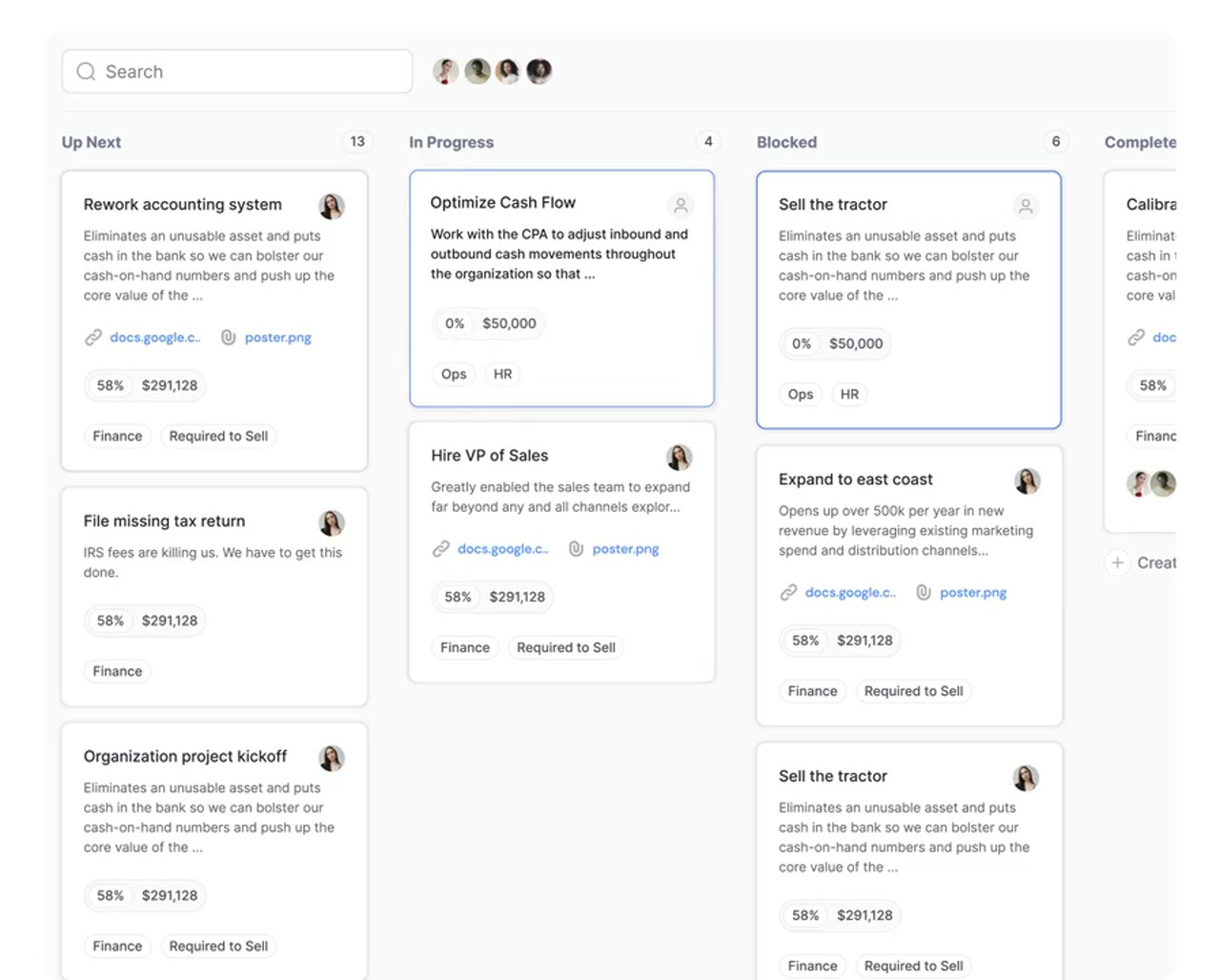
Weekly sessions with an advisor on the seats, the procedures, and the handoffs, with the task board tracking each one against the valuation it moves.
- In the processRework in the FNDRS process
- In the platformTask board
- ToolsGet your exit score
Questions
Owners ask
Twelve to eighteen months is typical for a founder-led company with a capable team, longer if the team has to be built. It is the reason the process starts years before a sale.
The more independent the business, the more choice you have. Buyers ask owners who are still central to stay, often with an earn-out. Owners who are not central negotiate the transition on their own terms.
Where do you stand on operational independence?
The exit-readiness score gives this pillar a mark from zero to one hundred and the three gaps worth closing first.