Sell your business

The FNDRS process

Twelve stages, from the first conversation to the day the money moves. Some founders start at the beginning and build value first. A founder ready to sell goes from the analysis straight to market, and the sale runs in four phases, roughly seven to twelve months from signing to the wire.

Typical timing, not a promise. The first five weeks are drawn wider than the months that follow them. A founder ready to sell goes from the analysis straight to market.

It starts with the number

Not a guess. A score, a valuation, and the drivers behind them, before anyone talks about a sale. A sale itself starts with the Go-To-Market Analysis.

The work is ordered by dollar impact

Each task on the roadmap carries the value it adds, so the weakest pillar with the biggest payoff gets fixed first.

The same team stays with you

The advisor who scored your business is in the room when the deal closes. Nothing gets handed to strangers.

The twelve stages

Twelve stages, one line of work

Scroll the line. Each stage lights as you reach it, with the teams who are in the room at that point and what changes hands. Founders ready to sell go from the analysis straight to market.

01

Stage 1 · Find the number

Gap Analysis (Discovery)

Where you are, and where you want to end up

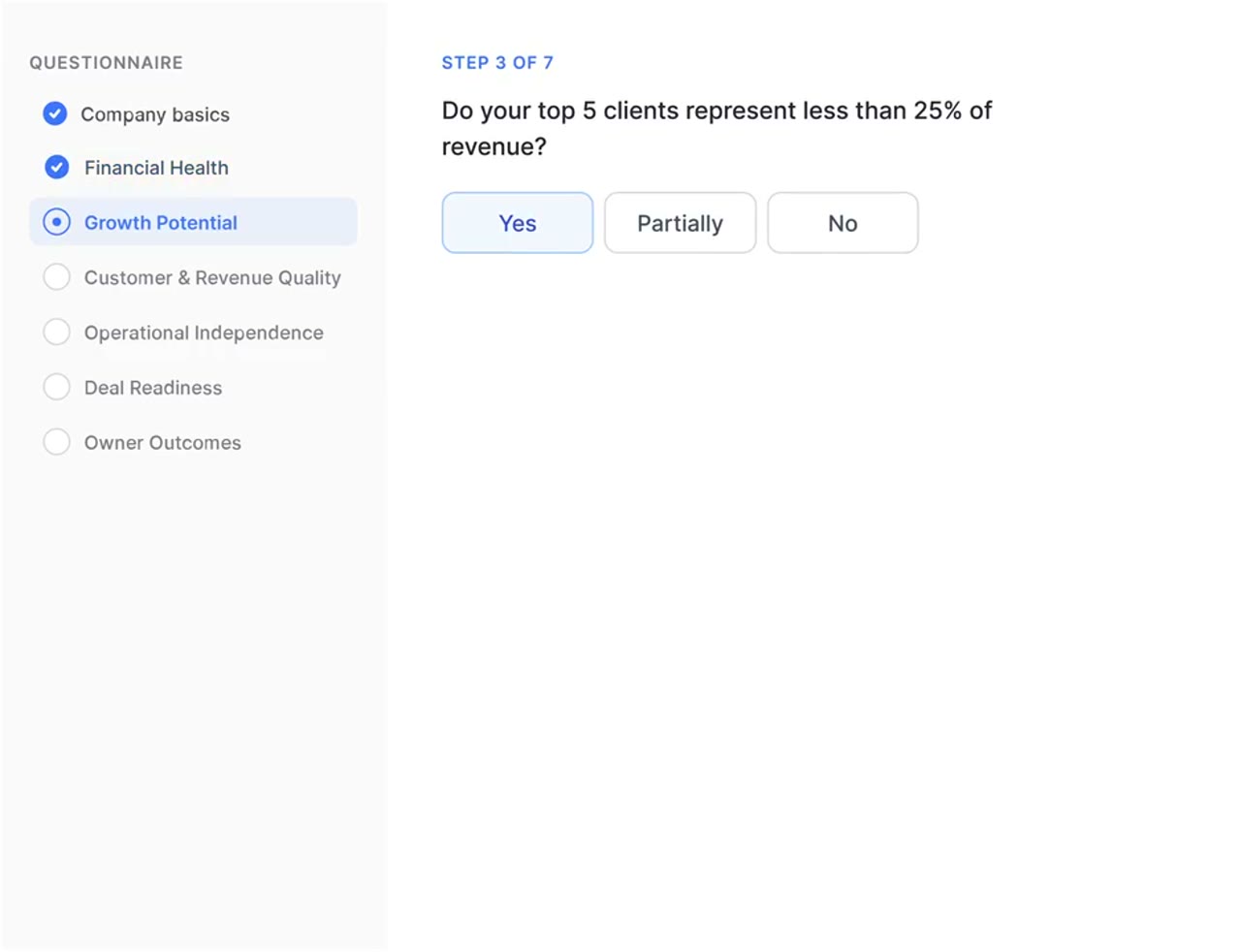
A conversation, not a pitch. We learn what you have built, what you want out of it, and when. You take the fifteen-minute exit-readiness assessment so the next conversation starts from a number. The right time for it is now, whatever your timeline.

What happens

  • A first call with an exit advisor
  • The exit-readiness score across the six pillars
  • Your number, your timeline, and what the day after looks like
  • An honest read on fit, both ways

What you leave with

  • Your exit score
  • A one-page read of the business
  • A recommended path: build first, or go to market
In the room
FEAFNDRS Exit AdvisorsWork the pillars between sessionsBABusiness AnalystsScore the pillars and draft the roadmap
02

Stage 2 · Find the number

Valuation

Full, comprehensive valuation of your business

The full valuation on the FNDRS platform walks through more than forty drivers in plain English, benchmarks you against real companies, and shows current value next to potential value with the gap between them. It sets the baseline every later stage is measured against.

What happens

  • The drill-down valuation, guided by an analyst
  • Benchmarks against peers, buyers' expectations, and industry averages
  • Current value against potential value
  • A buyer's-eye review of the result

What you leave with

  • A valuation you can explain to your board
  • The value gap, in dollars
  • The percentile you sit in today
In the room
FAFinancial AnalystsNormalize the numbers behind the valuationBABusiness AnalystsScore the pillars and draft the roadmapPTPlatform TeamThe scorecard, the task board, and the data
03

Stage 3 · Find the number

Analysis

Pillar by pillar

The scorecard breaks the valuation into the six pillars a buyer measures. We find the gaps that cost the most and attach a dollar figure to closing each one. Depending on the business and its needs, the analysis also goes deep on technology, AI, the financial record, and operations. A founder heading to a sale can take the Go-To-Market Analysis here: a buyer's read of the business from our Director of M&A, the add-backs tested line by line with your CPA, and three paths side by side with their total proceeds.

Where the analysis goes deep

Which tracks run depends on the business and what it needs. Each one ends in findings on the roadmap.

Technology audit

The whole footprint and topology, mapped

  • Every piece of software, hardware, and infrastructure inventoried
  • Customer touchpoints and the systems behind them
  • Automated generation of digital assets, and where it is missing
  • Domain authority, efficiencies, and throughput measured
  • Every other technological ramification for a buyer, named

What you leave with

  • In-depth technology audit result materials: diagrams, specifications, and roadmaps, depending on need and the time allotted
  • Detailed financial audit result materials: adjusted or newly created financials, reports, and data consolidations, depending on need and the time allotted
In the room
BABusiness AnalystsScore the pillars and draft the roadmapFEAFNDRS Exit AdvisorsWork the pillars between sessionsFAFinancial AnalystsNormalize the numbers behind the valuation
04

Stage 4 · Build the value

Map

Curated, scored tasks that build value

The gaps become a map: a curated list of tasks chosen for this business, each one scored by the value it adds, so the order of the work is clear. Nothing on the map is there by habit.

What happens

  • Tasks curated from the assessment, the valuation, and the analysis
  • Each task scored by the value it adds
  • The work put in order, and agreed with you

What you leave with

  • Planned tasks, laid out on a kanban board in the FNDRS platform
  • A task and phase roadmap laid out over the quarters ahead
In the room
FEAFNDRS Exit AdvisorsWork the pillars between sessionsBABusiness AnalystsScore the pillars and draft the roadmapPTPlatform TeamThe scorecard, the task board, and the data
05

Stage 5 · Build the value

Exit Accelerator

Assigned a FNDRS Exit Advisor and enter the accelerator program

Accelerator is the FNDRS plan that runs the work: an exit advisor on the plan, a personalized onboarding call, weekly advisor sessions, and monthly reviews, with the real-time valuation and the roadmap in the platform. Week by week, the work moves through the parts of the business a buyer will look at hardest.

What happens

  • A personalized onboarding call
  • Weekly sessions with your advisor
  • Monthly reviews of the roadmap with your exit advisor
  • The real-time valuation, moving as tasks close

What you leave with

  • Tasks closed, not just listed
  • A business that holds up under a buyer's questions
In the room
FEAFNDRS Exit AdvisorsWork the pillars between sessionsPTPlatform TeamThe scorecard, the task board, and the dataYTYour Leadership TeamCarries out the work inside the business
06

Stage 6 · Build the value

Rework

Close the gaps that cost the most

The gaps that cost the most are closed first, and the task board tracks every improvement against the valuation it moves. FNDRS advises and guides the work; your team performs it, unless you choose to engage FNDRS separately as a service provider for parts of it.

Where the rework can go

What runs here depends entirely on what you decide to do. Each track is a plan and guidance from FNDRS, carried out by your team, or by FNDRS if you engage us for it.

Technology overhaul

A plan for custom software, AI automation, and integrations

  • Guidance on where custom software would replace a tool that does not fit
  • A specification for AI automations in the workflows the audit scored highest
  • An integration plan for the software already in place
  • Vendor and license rationalization mapped out for your team to carry out

What you leave with

  • A rework plan your team can execute, with FNDRS guiding each step
  • Progress tracked on the task board, with the valuation tracker rising as tasks close
  • Books, systems, and records moving toward diligence-ready, at the pace you set
In the room
FEAFNDRS Exit AdvisorsWork the pillars between sessionsBABusiness AnalystsScore the pillars and draft the roadmapYTYour Leadership TeamCarries out the work inside the business
07

Stage 7 · Build the value

Scale

Grow into the multiple

With the foundations fixed, the work turns to growth a buyer can underwrite: revenue quality, margin, systems, and depth. Peers and partners from the FNDRS network join the room. The business is re-valued as the pillars move, until the target and the timing line up.

What happens

  • Growth plans built around what buyers reward
  • Recurring revenue, pricing, and margin work
  • Cohorts, workshops, and events with owners on the same path
  • Re-valuation as each pillar moves

What you leave with

  • A business worth what you need it to be worth
  • Readiness confirmed against the target
  • A decision on timing, made with data
In the room
FEAFNDRS Exit AdvisorsWork the pillars between sessionsCTCommunity TeamThe rooms, the cohorts, and the founder networkFAFinancial AnalystsNormalize the numbers behind the valuation
08

Stage 8 · Sell · Prepare and market

Go to market

Prepare the business, and take it to buyers

The M&A desk takes the lead, and the sale runs in four phases, roughly seven to twelve months from signing to the wire. Nothing goes to market before the engagement is signed. The financials are rebuilt to an institutional standard, you approve the CIM before any buyer sees it, and a confidential process takes the business to a list of buyers you have seen first.

What happens

  • The engagement signed: nothing goes to market before it
  • Prepare: the financials, the CIM, and the anonymous teaser, approved by you
  • Market: buyers who sign an NDA receive the CIM, and offers arrive by one date
  • Every offer compared side by side, and a shortlist

What you leave with

  • A CIM you approved
  • Several qualified buyers at the table at the same time
In the room
MAM&A TeamRuns the sale, the negotiation, and the closeDSDeal Support TeamMaterials, the data room, and diligence requests
09

Stage 9 · Sell · Select

LOI

Letters of intent, and the competition behind them

The shortlist meets you, sharpens its offers, and competes, and competition is what lifts offers. Offers are compared on what you keep and how certain it is, not on the headline. Signing one letter of intent opens diligence with the buyer you choose.

What happens

  • Management meetings with the buyers on the shortlist
  • Counter-offers, negotiated on price and on structure
  • A letter of intent signed by both sides

What you leave with

  • A signed letter of intent
  • A buyer you chose, not one you were left with
In the room
MAM&A TeamRuns the sale, the negotiation, and the closeFEAFNDRS Exit AdvisorsWork the pillars between sessions
10

Stage 10 · Sell · Close

Due diligence

The buyer checks everything

The buyer checks everything, usually with a quality of earnings review early on. The data room and the agreements for sharing it keep the materials in order. Buyers discount what they cannot verify, so a clean diligence leaves them less to price as risk.

What happens

  • Diligence begins, sometimes with visits on site
  • The buyer's quality of earnings review
  • Buyer questions answered from the data room

What you leave with

  • Diligence completed
  • Fewer surprises at the table
In the room
DSDeal Support TeamMaterials, the data room, and diligence requestsFAFinancial AnalystsNormalize the numbers behind the valuationACYour Attorney and CPAYour outside advisors at the table
11

Stage 11 · Sell · Close

Definitive agreement

Attorneys, and the mechanics of the transaction

The terms of the letter of intent become a binding agreement. The buyer drafts it, every legal team negotiates it, and the deal structure is settled in detail.

What happens

  • The purchase agreement drafted and negotiated
  • The deal structure settled
  • Closing conditions agreed

What you leave with

  • A signed definitive agreement
In the room
MAM&A TeamRuns the sale, the negotiation, and the closeACYour Attorney and CPAYour outside advisors at the table
12

Stage 12 · Sell · Close

Exit

The money moves

The deal closes and the wires go out on the day of closing. What comes next is planned before this day, not after it, alongside your own tax and wealth advisors.

What happens

  • Signing and closing
  • Funds transferred
  • The transition you agreed

What you leave with

  • Your exit
  • A plan for the proceeds and the day after
In the room
MAM&A TeamRuns the sale, the negotiation, and the closeACYour Attorney and CPAYour outside advisors at the table

The sale, phase by phase

Stages eight to twelve, in four phases

Once you decide to sell, the M&A desk takes the lead and the sale runs in four phases, after the Go-To-Market Analysis. Nothing goes to market before the engagement is signed, and no buyer sees the CIM before you approve it.

  1. 01Prepare
  2. 02Market
  3. 03Select
  4. 04Close

Signing to the wire: seven to twelve months. Every time given here is an estimate drawn from past engagements, not a commitment. Each sale runs on its own calendar, set by how ready and how complex the company is, by the buyers and their lenders, and by the lawyers on both sides. We set a calendar with you at kickoff and revisit it as the process moves. The full calendar, with who holds the clock

The process, from the founders who went through it.47 founders on film

All testimonials

Where the platform fits

Enterprise software for exiting your business

The FNDRS platform carries the valuation, the plan, and the progress from stage two onward.

  • Valuation, at stage two: more than forty drivers, benchmarked against real companies
  • Scorecard at the analysis, and the roadmap on the map: six pillars scored, every task carrying the value it adds
  • Task board and tracker through the accelerator, rework, and scale: progress on the plan, and the valuation rising as tasks close

What a buyer inspects

Fine from the deck is not what gets priced

Revenue is up, the team is busy, customers are happy. A buyer does not price the deck. Their accountant goes below the waterline, and what hangs there sets the discount: the decisions that wait for you, the customer who is a third of revenue, the numbers nobody can verify.

  • Owner dependence, customer concentration, and unverifiable financials are the three weights a buyer finds first
  • Each one cut loose before you go to market lifts the hull, and the price with it
  • The process starts below the line, not on the deck
Recurring RevenueRrManagement DepthMdOwner DependenceOdCustomer ConcentrationCcClean FinancialsCfWATERLINELOOKS FINE FROM THE DECKTHREE WEIGHTS · TAKING ON WATERTWO CUT LOOSE · HULL LIFTSBUOYED · NOTHING BELOW THE LINE

Below the waterline

DeckHullCut looseBuoyed

From the deck. Revenue is up, the team is busy, customers are happy. Rr, recurring revenue, and Md, management depth, are pulling their weight. The business looks fine from above.

Who is across the table

Five kinds of buyer, five different deals

The process brings more than one of them to the table so the terms are set by competition.

Strategic acquirer

Wants
Your customers, product, or territory added to theirs.
Pays
Often the highest price when the fit is real, with synergies priced in.
Watch for
Integration risk for your people and brand.

Private equity platform

Wants
A durable business to build on with add-on acquisitions.
Pays
A market multiple, with rollover equity for a second exit.
Watch for
Leverage on the balance sheet and reporting cadence.

Private equity add-on

Wants
A bolt-on to a company they already own.
Pays
A multiple close to the platform's, with faster diligence.
Watch for
Earn-outs tied to integration milestones.

Family office

Wants
Long-term cash flow, often with the founder staying involved.
Pays
Patient capital and flexible structure.
Watch for
Slower processes and fewer competing bids.

Individual or search fund

Wants
A business to run themselves.
Pays
Bank-financed prices with seller notes common.
Watch for
Financing contingencies and transition demands.
Scott Stepanik

Scott StepanikDirector of M&A

Who leads the sale

Every sector has a range buyers usually pay. Scott Stepanik leads the work on where a business lands in it.

Scott leads every FNDRS sale, with the M&A team alongside. The multiple a founder takes home is decided long before the first offer arrives: in the analysis, the story, the process, and the structure. Bring Scott in before you go to market, and those four are built for you.

How Scott runs a sale

  1. Answer every question firstWeeks of quantitative and qualitative analysis before anything goes to market, so the materials answer every question a buyer or investor will ask. Leverage at the letter of intent starts here: a factual, compelling story that leaves a buyer no risk to price.
  2. Tell the right storyOperational maturity, technology that sets the business apart, and the quality of its revenue, put in the terms a buyer underwrites.
  3. Run a competitive processA disciplined process with several qualified buyers at the table at once, so the tension between them sets the price.
  4. Structure to close the gapWhere buyer and seller see different numbers, the structure bridges them, so the total value to the shareholders is the number that counts, not the headline.

Deals the FNDRS M&A team has advised on

Advised by members of the FNDRS M&A team, including at prior firms

Who you work with

The same team, start to close

The people who value the business are the people who sell it, with Scott Stepanik leading every sale.

Meet the team
Nick Long

Nick Long

CEO and co-founder

Exit advisor

Troy Hoffman

Troy Hoffman

Co-founder

Serial entrepreneur

Scott Stepanik

Scott Stepanik

Director of M&A

Sell-side M&A

Shawn Livermore

Shawn Livermore

CTO

The FNDRS platform

Ashley Smith

Ashley Smith

COO

Jeff Klubeck

Jeff Klubeck

Director of community

Cohorts, workshops, and events

Cecilia Camacho

Cecilia Camacho

Business and operations

Systems, processes, and events

Jack Douglas

Jack Douglas

Senior exit advisor

Valuation, value gaps, and exit planning

Marisa Tricarico

Marisa Tricarico

Exit advisor

Growth strategy and investment prioritization

Adrian Adderley

Adrian Adderley

Exit advisor

Finance and operations executive

Russ Prag

Russ Prag

Director of acquisitions

Main Street Acquisitions

What you receive

Nothing left to memory

01

Deal workbook

Adjusted EBITDA with every add-back tested, and the yellow and red flags a buyer would raise.

02

Confidential information memorandum

The business, the numbers, and the opportunity, written for a buyer.

03

Financial model

Normalized earnings, add-backs, and a forecast a buyer can underwrite.

04

Data room

Indexed, complete, and ready before the first request arrives.

05

Buyer list and outreach log

Who was contacted, who signed, who bid, and why.

06

Offer comparison

Every letter of intent side by side on value, terms, and certainty.

07

Closing checklist

From signed letter of intent to funded close, nothing left to memory.

08

Buyer NDAs

Signed by every buyer that sees the CIM: no contact with your people, no hiring them, no going around us.

The record

A young firm, an experienced team

FNDRS is a young firm. The people who run its sales are not new to the work: members of its M&A team have advised on sales across the United States, Europe, Latin America, and the Middle East, much of that work at prior firms. Every deal on the results page is credited to the members of the M&A team who advised on it, including at prior firms.

Deal terms, in plain English

The words that decide the price

The full list lives in the glossary.

Open the glossary
EBITDA
Earnings before interest, taxes, depreciation, and amortization. The number most buyers multiply.
Multiple
The factor applied to EBITDA or revenue to reach enterprise value. It rises with the six pillars.
Enterprise value and equity value
What the business is worth in total, and what you receive after debt and cash are settled.
Working capital peg
The normal level of working capital the buyer expects to be left in the business at close.
Earn-out
Part of the price paid later, if the business hits agreed targets after close.
Rollover equity
A share of your proceeds reinvested in the buyer's company for a second exit.
Escrow and holdback
Part of the price held back for a period to cover claims under the purchase agreement.
Letter of intent
The non-binding offer that sets price and key terms, usually with a period of exclusivity.

Questions

Before you start

No. The right time to start the conversation is now, whatever your timeline. Discovery and the valuation tell you where you stand; the map, the accelerator, rework, and scale exist for owners who are not ready yet. A founder ready to sell goes from the analysis straight to market.

Usually seven to twelve months from signing to the wire, for a company that is ready. Preparation is the variable: a company with clean books and a ready data room moves faster than one that needs rework first. Every time given here is an estimate drawn from past engagements, not a commitment.

Scott Stepanik. Scott leads every FNDRS sale, from the first read of the numbers to the close, backed by the deal team.

An exit advisor owns the relationship from discovery onward. Advisors run the weekly sessions on the Accelerator plan through rework and scale, an analyst supports the valuation, and Scott Stepanik and the deal team lead the sale.

The exit score and the Core valuation are free, and the build work runs on the Accelerator plan. The Go-To-Market Analysis is $10,000, flat, and it is credited in full against the fee for the sale if you go on to engage us. A sale is a retainer and a success fee, and the retainer is credited against the success fee. The figures depend on the size of the business, so we set them with you on a call. On a sale we run for you, you are the only one who pays us. A buyer pays us nothing.

Buyers see a blind teaser first. Only parties that sign a non-disclosure agreement receive the memorandum, and only shortlisted buyers meet management. Every buyer that signs agrees not to contact your people, not to hire them, and not to go around us, and you can enforce that agreement yourself. Employees, customers, and competitors learn about the sale when you decide they should.

No. Offers are compared on value, structure, certainty of close, and fit for your people. The highest headline number is often not the best deal once terms are understood.

Then we say so. A valuation that shows a large gap is a reason to build, not to list. The roadmap exists so the wait is productive and measured.

On the platform. The task board tracks every improvement, the valuation tracker shows the number moving as tasks close, and the scorecard is re-run as pillars change.

Start with the number

Fifteen minutes and six pillars give you an exit score. A sale starts with the Go-To-Market Analysis. Both start with a conversation, and the right time for it is now.