
Business valuation
Know what your business is worth today
A valuation is not one number from one method. It is earnings, the multiple a buyer will pay for them, and the risk sitting behind both. Here is what goes into one, how to get one, and what to do with the answer.
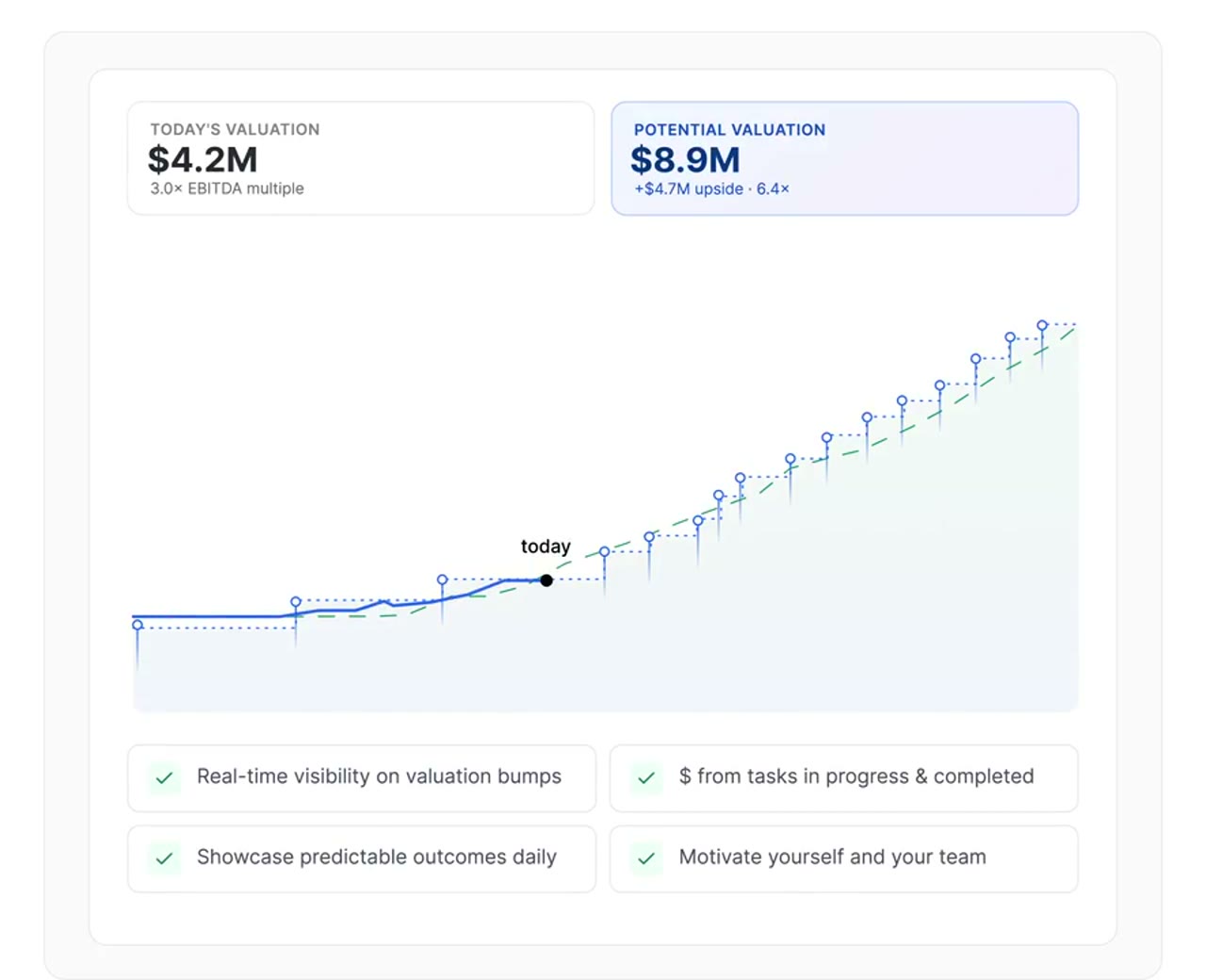
What goes into it
Earnings, the multiple, and the risk behind both
Normalised earnings set the base. The multiple is a judgement on growth, concentration, and how much of the business walks out of the door with you. Adjust for net debt and working capital and you have the number buyers argue about.
Normalised earnings
Profit as a buyer will see it: the owner's pay set at a market rate, one-off costs taken out, personal expenses added back, every adjustment documented. Usually EBITDA or seller's discretionary earnings, depending on size.
The multiple
What a buyer will pay for each dollar of those earnings. It moves with growth, recurring revenue, customer concentration, and how much of the business depends on you. Two businesses with the same profit can sell at very different multiples.
The balance sheet
Enterprise value is not what you take home. Net debt comes off, and the working capital the business needs to run is left behind at close. The adjustments are agreed, not assumed.
The buyer
A strategic acquirer, a private equity fund, and an individual buyer price the same business differently. The likely buyer sets the range the number sits in.
Two of the four are judgements, not arithmetic. That is why two valuations of one business rarely agree.
The guess
Most owners are working from a guess
Most owners plan around a figure they have never tested. When an offer arrives, there is nothing to measure it against, and the buyer's number becomes the only number in the room.
- A figure you have not tested is a hope, not a plan
- Without a baseline, you cannot tell a fair offer from a low one
- The time to find out is years before a sale, not the week of one
Only 0% of Boomer owners have ever had their business formally valued.
Ways to get one
Five routes to a number, and what each is for
A calculator answers in a minute and is worth about that much. An appraisal answers a tax question. A broker's opinion answers what the market might bear. Pick the method that matches the decision in front of you, and know what it cannot tell you.
An online calculator
- For
- A first sense of scale
- Time
- Minutes
Where it falls short. It applies an average multiple to the figure you type in. It cannot see the risk in your business, so it cannot tell you why the number is what it is.
A broker's opinion of value
- For
- What the market might bear today
- Time
- Days to a couple of weeks
Where it falls short. It reads recent sales of similar businesses. It is a view on price, not a plan to change it.
An accountant's report
- For
- Earnings you can rely on
- Time
- Weeks
Where it falls short. Strong on the numbers and the adjustments, lighter on what a buyer will pay for them.
A formal appraisal
- For
- Tax, estate, lending, or a dispute
- Time
- Weeks, with a fee to match
Where it falls short. Built to a standard a court or the IRS will accept. Rigorous, but a fair market value is not the price a motivated buyer pays.
An advisory platform
- For
- A number you can work on
- Time
- Ten minutes to start, then ongoing
Where it falls short. The FNDRS valuation reads the elements behind the figure, scored today and at target, so the number comes with the work that moves it. It is not a substitute for a formal appraisal where one is required.
Inside the platform
From the first conversation to a number you can work on
The FNDRS valuation is built in four steps on the platform. Step through them to see what each one does.
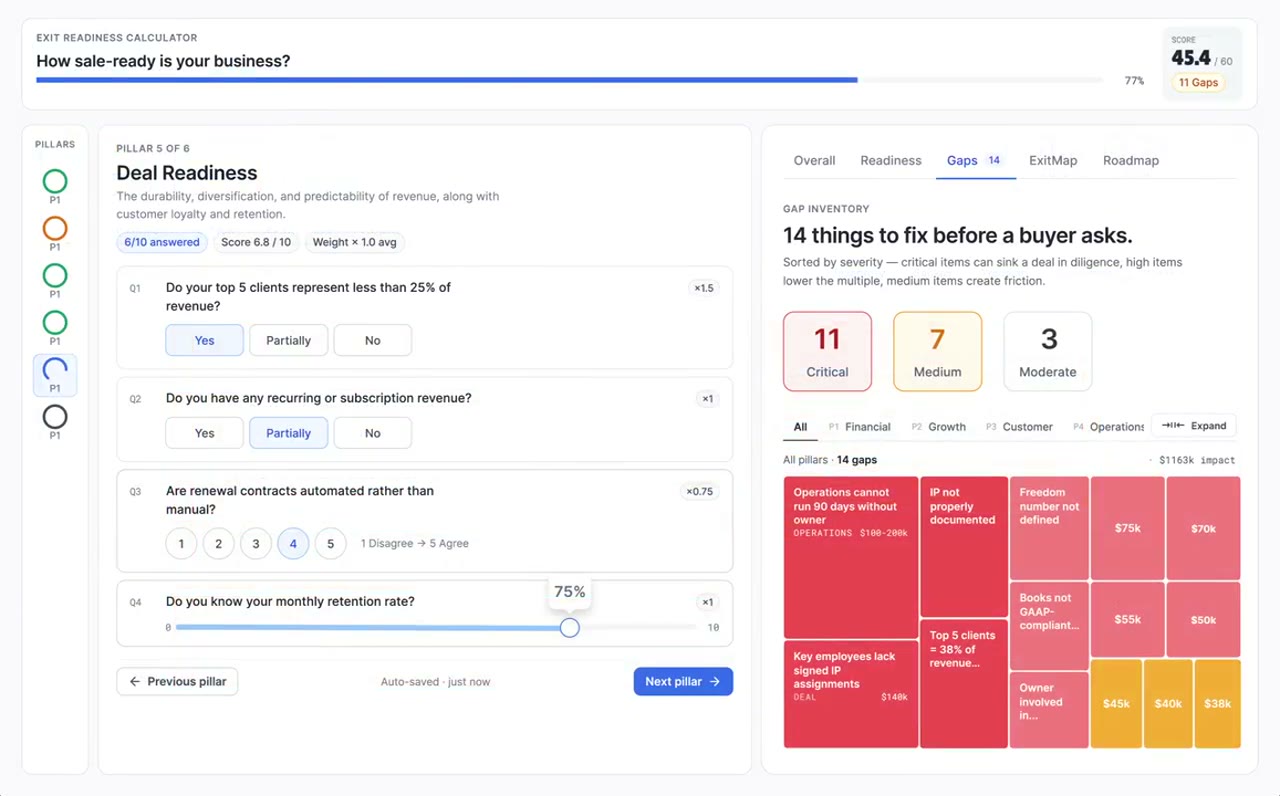
01 / 04 · Discovery
Gap calculator
Meet with a FNDRS specialist to find the gaps in your business and the value they are costing you, in the hundreds of thousands or the millions.
FNDRS Elements
The elements that set the multiple
Buyers do not pay for revenue. They pay for earnings they believe will survive the handover. These are the elements that decide which way that judgement goes, scored today and at target.
- Rr09 · Recurring RevenueRevenue that repeats under contract or habit without being re-sold each period.
- Od19 · Owner DependenceHow much of revenue, relationships, and decisions route through the owner. Scored as control: higher is safer.
- Cf11 · Clean FinancialsAccrual books, reconciled monthly, that survive a quality-of-earnings review.
- Cc21 · Customer ConcentrationRevenue share held by the top customers. Scored as control: higher is safer.
The six pillars
The six report cards a buyer reads
Every buyer, lender, and diligence team reads a company on the same six things. The 36 FNDRS Elements® roll up into them, and the exit-readiness score gives each one a mark from zero to one hundred.
 1:49
Whiteboard session
Nick on enterprise value
Nick works through this element as in an FNDRS workshop: what a buyer is really asking, how the score moves, and the first thing to fix.
 Nick LongCEO and co-founder
Scoring
Scored today, and scored at target
A FNDRS valuation is not a figure on a page. Every element carries a score today and a score at target, and the gap between the two is the work. The number is the output; the scores are the instructions.
- Where each element stands now
- Where it needs to be before a buyer looks
- The tasks that close the gap, in order
Dependence
What owner dependence does to the price
Two businesses with the same earnings, one that runs without its owner and one that does not. Buyers price the difference hard, and some owner-dependent businesses do not sell at all. A buyer works out which one you are with three questions.
- Who holds the customer relationships?
- Who makes the decisions when you are not there?
- What stops working if you take a month off?
at sale. If they sell at all.
Questions
What owners ask about a valuation
From nothing to tens of thousands of dollars. An online calculator is free. A broker's opinion of value is often free when it leads to a listing. A formal appraisal for tax or litigation carries a professional fee that grows with the size and complexity of the business. The FNDRS exit score is free to start.
Minutes for a calculator, about fifteen minutes for the exit score, days to a couple of weeks for a broker's opinion, and several weeks for a formal appraisal. Most of the time goes into gathering and normalising the financials.
You can estimate it: normalise the earnings, find a fair range of multiples for your industry and size, and adjust for net debt. The hard part is the multiple, because it is a judgement on risk, and owners are rarely neutral about their own risk. An outside view earns its keep there.
A valuation is an estimate of what the business is worth. An offer is what one buyer will pay, on their terms: how much is cash at close, how much is deferred or tied to performance, and what you have to leave behind. Two offers at the same headline price can be worth very different amounts.
At least once a year, and after anything that changes the business: a large customer won or lost, a key hire, a new recurring revenue line. A number that is a year old describes a business that no longer exists.
A formal appraisal, done to a recognised standard by a credentialed appraiser. Lenders, estate filings, gifting, and disputes need a figure that will stand up to review. An advisory valuation answers a different question: what a buyer will pay, and what you can change before one looks.
Next step
Two ways to get your number
One takes fifteen minutes and costs nothing. The other is a conversation with the people who run the sale. Start with whichever matches how close you are.
A number is only useful if you can move it
Find out what the business is worth today, what it could be worth, and the elements that close the gap.